
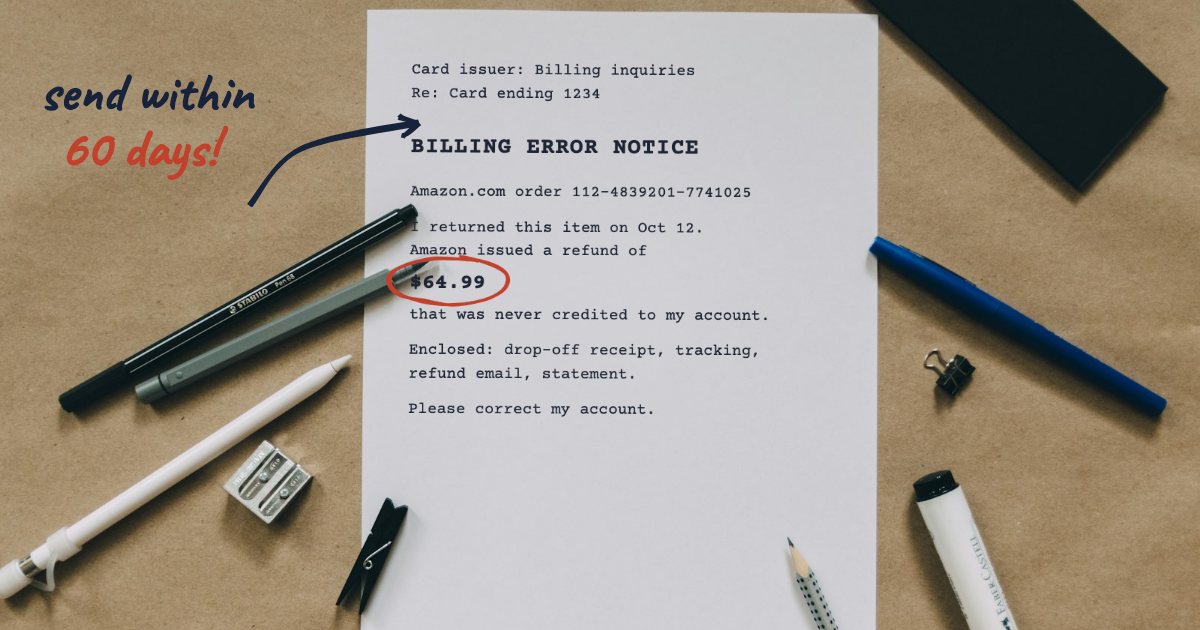
If Amazon won't reissue a refund that never posted, or won't reverse a charge for something you returned, your card company is the next step. How much protection you get depends on whether you paid by credit or debit card, and the deadlines are short, so keep an eye on your statement dates.
Try Amazon first
Customer service can reissue a refund or reverse a charge without a formal dispute, and a credit card dispute can take up to 90 days to resolve. Send them the order number, the refund date and amount Amazon showed, and your drop-off receipt, and ask for an escalation if the first answer is no. Our guides to missing refunds and charges for returned items have messages you can copy.
If a third-party seller sold the item, file an A-to-z Guarantee claim before you go to your bank. Amazon's A-to-z page says you can't get a refund through it once you've asked your payment provider for a refund or chargeback.
Credit cards: the Fair Credit Billing Act
The FTC's guide says the law's billing error process covers a bill for something you returned, and credits for returns that weren't posted. Both of the usual Amazon problems fit.
- Call the card issuer and tell them about the problem.
- Write to the issuer at the address for billing inquiries (not the payment address). Give your name, address and account number, and describe the error. The letter has to reach them within 60 days after the first bill with the error was sent to you. The FTC has a sample letter, and suggests certified mail with a return receipt.
- Include copies, not originals, of your evidence (see below).
The issuer must acknowledge your letter in writing within 30 days and resolve the dispute within 90 days. Meanwhile you can withhold payment on the disputed amount and related charges, though you still owe the rest of the bill. The issuer can't close your account or report you as delinquent for disputing in good faith. If you already paid the charge, the CFPB says you probably won't get the money back until the issuer decides in your favor.
Debit cards: call right away
Federal debit card rules are written for unauthorized and incorrect transfers out of your account. A refund Amazon never sent, or a charge Amazon meant to make (such as a re-charge for a return it says never arrived), may not fit those rules, so the protection is weaker than on a credit card. Your bank may still be willing to dispute it with the merchant, so call as soon as you notice and ask what deadline your account agreement sets.
When a bank does treat it as an error, the CFPB says banks generally have 10 business days to investigate, or up to 45 days if they give you a provisional credit for the disputed amount while they look into it.
What to send
- The order number and the item.
- The return confirmation email and your drop-off receipt.
- Return tracking that shows delivery to Amazon.
- A screenshot of the refund in Your Returns, or Amazon's refund email, with the date and amount.
- The statement lines: the original charge, any refund, and any new charge.
- Your chat transcripts with Amazon.
If the card company says no
Ask for the documents they relied on. On a credit card, you can appeal in writing within 10 days of their explanation, or within the payment period they give you if that's longer. You can also file a complaint with the Consumer Financial Protection Bureau.
Find the refunds worth disputing
The 60-day credit card deadline starts with the statement, so a refund you only notice months later can be past it. Recoup Hero matches your Amazon refunds to your bank and card statements, and lists the ones that never arrived and any return Amazon charged you for again, with a ready-to-send message for each. It keeps checking as new refunds come in, so you hear about a missing one while there's still time to dispute it.
How do I dispute a charge with Amazon itself?
Contact Amazon customer service from the order in Your Orders and give the order number, the charge date and amount, and what's wrong with it. For an item sold by a third-party seller, file an A-to-z Guarantee claim. Go to your card company only if Amazon won't fix it.
Should I dispute with my bank or contact Amazon first?
Amazon first. Customer service can reissue a refund or reverse a charge without a formal dispute, and a credit card dispute can take up to 90 days to resolve. If the item came from a third-party seller, file an A-to-z Guarantee claim before going to your bank, because Amazon won't pay an A-to-z claim once you've asked your card company for a chargeback.
How long do I have to dispute an Amazon charge on my credit card?
Under the Fair Credit Billing Act, your written dispute has to reach the card issuer within 60 days after the first statement with the error was sent to you. Call the issuer too, but the letter is what the law protects.
Does a debit card dispute work the same way?
No. Federal debit card rules are written for unauthorized and incorrect transfers, so a refund Amazon never sent may not fall under them. Your bank may still be willing to dispute it with the merchant, so call quickly and ask what deadline your account agreement sets.
Do I have to pay the disputed amount while the card company investigates?
On a credit card, no. The FTC says you can withhold payment on the disputed amount and related charges during the investigation, though you still owe the rest of the bill. If you already paid, the CFPB says you probably won't get the money back until the card company decides in your favor.
What if the card company decides against me?
Ask for the documents they relied on. For a credit card, you can appeal in writing within 10 days of their explanation, or within the payment period they give you if that's longer. You can also file a complaint with the Consumer Financial Protection Bureau at consumerfinance.gov/complaint.
This guide is general information, not legal advice. Your card agreement has the exact terms for your account.